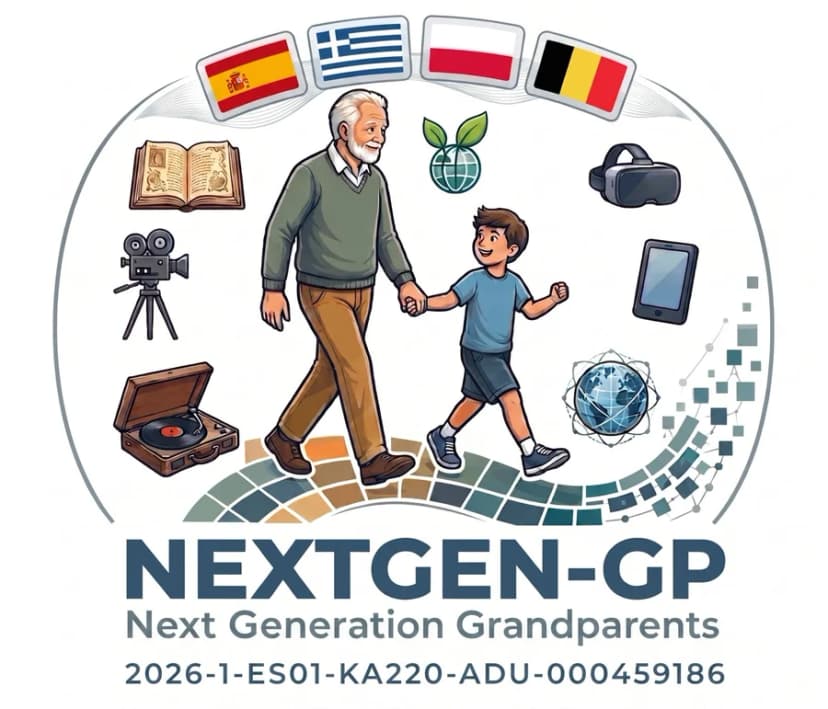
NextGen-GP
Next Generation Grandparents: enhancing the grandparents–grandchildren bond through creativity, technologies and sports
Turning the hours grandparents spend babysitting children aged 5–12 into active, skill-building time together — through creative arts, accessible technology and gentle movement.
The aim
To empower seniors 60+ and adult educators with a methodology that transforms passive babysitting into active, co-creative and skill-building bonding — bridging the generational divide through creative arts, accessible technologies and physical well-being, combating the digital and social isolation of older adults, and publishing the whole approach as open educational resources on an accessible digital hub.
Objectives
- 1Empower seniors with fewer opportunities — low digital skills, cultural barriers — by building self-confidence and emotional well-being through shared activities in creativity, accessible technology and active ageing.
- 2Equip adult educators and community organisations with a competence framework and a modular training programme, so they can facilitate intergenerational engagement instead of supervising traditional care.
- 3Foster social inclusion and preserve cultural heritage by keeping older adults active, connected members of their families, working through shared family history.
- 4Ensure long-term sustainability through open educational resources any adult education organisation can pick up and replicate.
About the project
Across Europe, working parents increasingly rely on grandparents for informal childcare. Those hours are a huge, unused learning opportunity: they are often spent in mutual frustration, with technology in the middle of it, rather than in shared activity. NextGen-GP turns that time into something both generations gain from.
The project builds one integrated competence model instead of separate courses in digital literacy, well-being and physical activity. Grandparents learn to navigate a tablet while co-designing a craft with a grandchild, build resilience through light intergenerational sport, and gain technological confidence through creative work — so learning feels like family play rather than a formal requirement.
The materials are co-designed from the ground up. Grandparents, children, adult educators and local families take part in focus groups, test the digital hub and shape the competence framework, which keeps the activity cards realistic and adaptable from rural southern communities to more isolated northern households.
TeneLearning coordinates the partnership with OIKANOS (Greece), Welcome Home International (Belgium) and Fundacja Eurointegracja (Poland). Everything the project produces is free and open.
Results & outputs
Everything we produce is an open educational resource — free to download, use and share.
Transnational needs analysis report
Qualitative findings from local focus groups in Spain, Greece, Belgium and Poland.
NextGen-GP competence framework
Learning outcomes for seniors across the digital, creative and physical domains.
Educational toolkit — 24 activity cards
Three modules: digital storytelling & creative expression, active ageing & health literacy, mindfulness & emotional well-being. Five languages, open access.
Facilitator handbook and curriculum
How adult educators run the intergenerational programme locally.
Interactive digital hub
Accessible web platform (WCAG 2.1 AA) for family memories, results and a community of practice.
Sustainability package
Guidelines for municipalities and NGOs on embedding the resources in regular adult learning.
Expected outcomes
- A transnational needs analysis report mapping what grandparents actually need and what stands between them and digital-native children.
- A competence framework defining learning outcomes for seniors in the digital, creative and physical domains.
- A facilitator handbook and curriculum — a step-by-step guide for adult educators delivering the programme locally.
- An educational toolkit of 24 activity cards, translated into five languages and published as an open educational resource.
- An interactive digital hub for family memories, project results and a community of practice — aiming at 5,000+ unique visitors.
- 16 adult educators trained, 120 seniors and children directly involved, and a sustainability package for municipalities and NGOs.
Project facts
- Action type
- KA220-ADU
- Our role
- Coordinator
- Duration
- Sept 2026 – Aug 2028
- Project number
- 2026-1-ES01-KA220-ADU-000459186
The consortium
- TeneLearningSpain
- Social Cooperative Enterprise of Collective and Social Benefit (OIKANOS)Greece
- Welcome Home InternationalBelgium
- Fundacja EurointegracjaPoland
Who it is for
Older adults aged 60+ with fewer opportunities — isolated elderly, migrants with low digital skills, rural residents in Spain, Belgium, Greece and Poland — together with children aged 5–12 who lack meaningful relationships with mature role models. Secondary: families with weakened generational ties, adult educators, community centres, senior care organisations and local policymakers.
Other projects
KA210-YOU
GREENOVATE
Green entrepreneurship and the circular economy for young people — turning waste into products through upcycling.
KA210-ADU
Hold on, be STRONG!
Active ageing, social inclusion and digital literacy for seniors 60+, with a special focus on migrants and refugees.
KA210-ADU
FORTUNATE PARENT
Employability, financial literacy and digital skills for single parents — and better tools for the educators who support them.
Funded by the European Union. Views and opinions expressed are however those of the author(s) only and do not necessarily reflect those of the European Union or the European Education and Culture Executive Agency (EACEA). Neither the European Union nor EACEA can be held responsible for them.
← All projects